

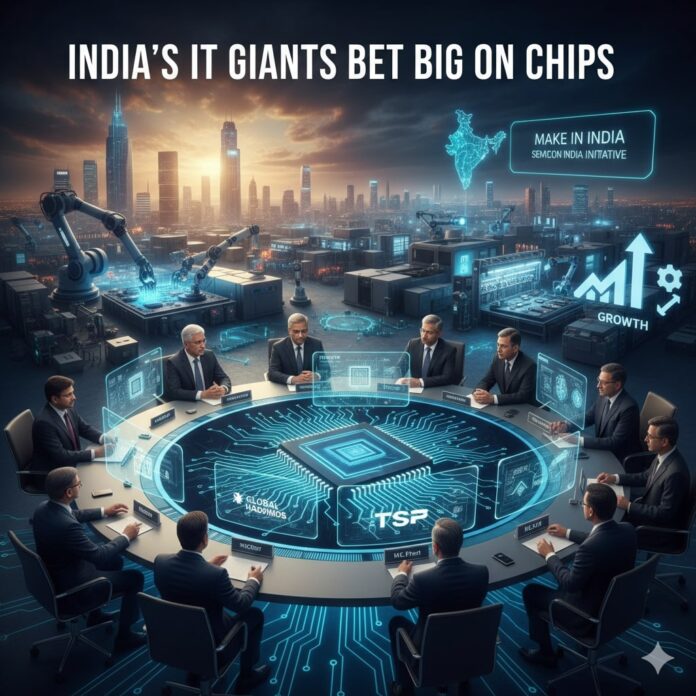
Bengaluru: India’s leading IT services companies are making strategic moves into the semiconductor and electronics sectors, viewing the high-growth industries as a way to diversify beyond traditional software services and safeguard against global market uncertainties.
Industry experts believe that the country’s IT majors are well-positioned to leverage their R&D capabilities, engineering talent, and global client relationships to tap into India’s emerging semiconductor ecosystem. This shift comes as New Delhi accelerates its push to create a self-reliant chip manufacturing and design value chain through incentives and policy support.
Key Moves by Major Players
- Wipro recently acquired a stake in Harman’s Digital Transformation Solutions business for $375 million, a deal expected to close by December 31, 2025. The acquisition includes a multi-year strategic partnership with Harman and its parent company Samsung, strengthening Wipro’s electronics and embedded engineering portfolio.
- Wipro also operates Wipro Pari, which services large manufacturing companies with high-end machinery, signaling its growing interest in industrial automation and electronics.
- HCL Group, in collaboration with Foxconn, is setting up a semiconductor fabrication (fab) facility in Noida, with an investment of ₹3,706 crore. The project, cleared by the Union Cabinet in May 2025, marks one of the most significant private Indian investments in chip manufacturing.
- Infosys has strengthened its semiconductor services with the acquisition of Bengaluru-based embedded design firm InSemi for around ₹280 crore. The move boosts its chip design and embedded systems capabilities.
- Cyient, a mid-sized IT player, has launched a fully owned semiconductor subsidiary, while L&T has rolled out L&T Semiconductor Technologies to support group companies such as L&T Technology Services and Mindtree-LTI in semiconductor R&D and design.
- Tata Consultancy Services (TCS) recently unveiled chiplet-based system engineering services to accelerate semiconductor innovation. TCS is also collaborating with Tata Electronics, which plans to launch India’s first domestically produced chips by 2026. Tata Electronics is building facilities in Gujarat and has partnered with Taiwan’s Powerchip Semiconductor Manufacturing Corp to bring advanced chipmaking capabilities to India.
National Push Creates Opportunity
According to Pareekh Jain, founder and CEO of technology insights platform EIIRTrend, Indian corporates are “investing in the semiconductor ecosystem with either design, OSAT (outsourced semiconductor assembly and test), or wafer manufacturing capabilities through group subsidiaries.”
The Indian government has been aggressively promoting its Semicon India initiative, offering billions of dollars in subsidies and incentives to attract global chipmakers and support domestic champions. This includes encouraging joint ventures, research partnerships, and infrastructure development in states such as Gujarat, Karnataka, and Uttar Pradesh.
Why IT Services Are Getting Involved
Experts say diversification is a de-risking strategy for IT majors, especially at a time when the global IT outsourcing market faces margin pressure, slower growth in digital transformation projects, and geopolitical risks like U.S.–China trade tensions and tariff uncertainties.
“India’s strong policy push and the global shortage of chips make this the perfect moment for IT firms to move beyond services and participate in the semiconductor value chain,” said an industry analyst. These companies already service some of the world’s largest chip design and manufacturing firms, giving them a natural edge.
The Road Ahead
While building fabs and semiconductor plants is capital-intensive and technologically demanding, India’s IT sector brings deep engineering expertise and global client access, enabling them to start with chip design, OSAT services, embedded systems, and automation solutions before expanding into manufacturing.
If successful, this pivot could position India not only as a global hub for chip design and electronics manufacturing but also as a critical player in next-generation technologies such as AI hardware, IoT devices, and automotive semiconductors—sectors expected to drive multi-billion-dollar opportunities in the next decade.