

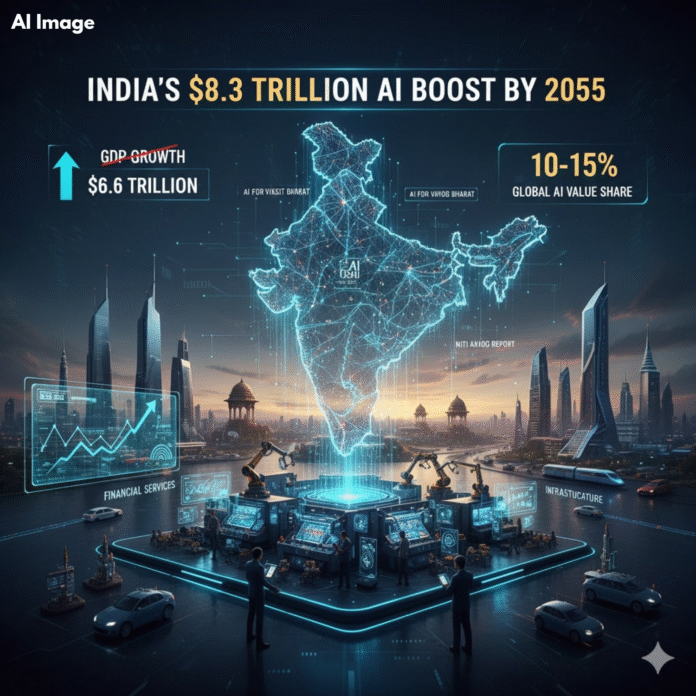
New Delhi: India stands on the cusp of an AI-driven transformation that could deliver an additional $500–600 billion to its GDP by 2035 — well above what is already projected under current growth trajectories — according to a newly released NITI Aayog report titled “AI for Viksit Bharat: The Opportunity for Accelerated Economic Growth.”
The report lays out a roadmap for how accelerated adoption of Artificial Intelligence across sectors, combined with stronger research & development, can help bridge the gap between India’s projected GDP of $6.6 trillion by 2035 (assuming current growth) and a more ambitious target of $8.3 trillion — in line with the “Viksit Bharat 2047” vision. The Financial Express+2The
Key Findings & Highlights
Sectoral Gains:
The sectors expected to benefit the most are financial services and manufacturing. By 2035, up to 20–25% of the output in these sectors could be attributed to AI-driven productivity, efficiency, and innovation.
In financial services, AI-enabled advances — in fraud detection, automated compliance, risk management, and data-driven lending — could unlock $50–55 billion in incremental gains.
In manufacturing, enhancements like predictive maintenance, smart factories, real-time quality control are projected to drive an additional $85–100 billion above current trends.
Global Positioning:
India could potentially capture 10–15% of global AI value, leveraging its large STEM workforce, expanding R&D ecosystem, and improving digital infrastructure.
Innovation & R&D:
Generative AI, new AI-led business models, and frontier technologies like drug discovery, software-defined vehicles, advanced computing are identified as critical levers for unlocking further economic value.
Growth Trajectory:
To reach the Viksit Bharat goal of around 8% annual growth, India needs to raise productivity and innovation significantly. The report suggests that AI adoption and R&D transformation can account for nearly half of the growth uplift needed to move from the baseline trajectory ($6.6 trillion) to the aspirational $8.3 trillion by 2035.
Job & Skills Implications:
While AI will create higher-value roles, it is also expected to displace jobs in routine, clerical, and low-skill tasks. The report underscores the urgency of upskilling, reskilling, and building inclusive AI ecosystems so benefits are widely shared.
Regulatory & Ethical Frameworks:
To harness AI’s potential safely, the report calls for strong, adaptive regulation — especially around privacy, data governance, fairness, and accountability.
Infrastructure & Investment Needs:
Improvements needed include better AI infrastructure (compute, data platforms), higher investment in R&D, and expanding digital access, especially in smaller towns and rural areas.
Stakeholder Collaboration:
The report emphasizes collaboration between government, industry, academia, and civil society to drive AI adoption responsibly, align incentives, and ensure skill development programs reach all layers of society.